Donald Trump And The Pearl Harbor Gambit
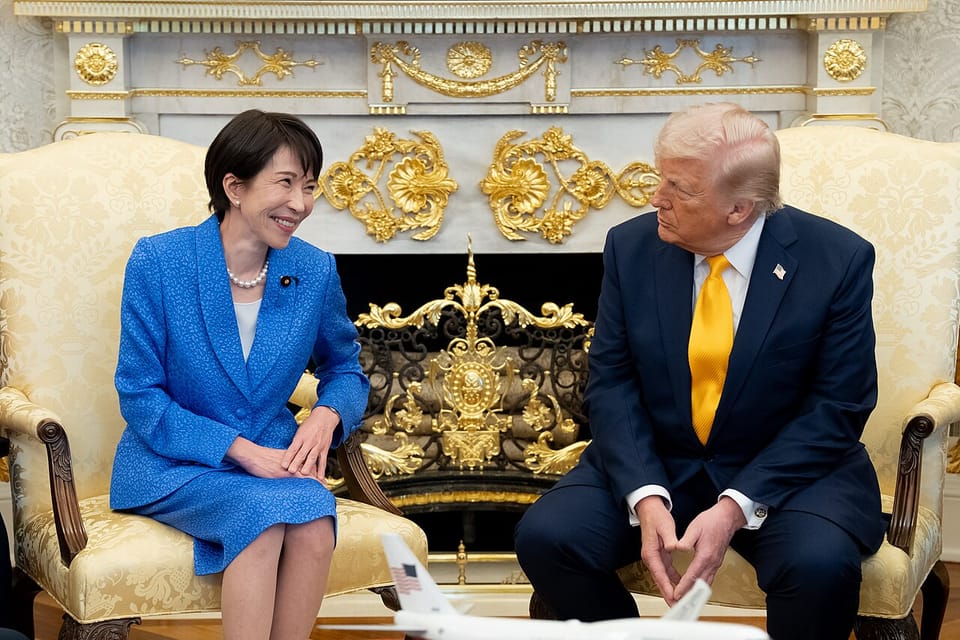
On Thursday and Friday of this week, March 19–20, 2026, Japanese Prime Minister Sanae Takaichi visited the White House in her first visit since becoming Japan’s leader. While most of the visit proceeded according to protocol and decorum, one exchange between the Prime Minister and President Trump will likely become a defining moment in Trump’s presidency and in his pursuit of war with Iran.
A Japanese reporter asked Trump why he did not tell the American allies about his attack on Iran ahead of time. Trump responded:
“Too much, you know, when we went in, we went in very hard, and we didn’t tell anybody about it because we wanted to surprise, who knows better about surprise than Japan.
[laughter] Okay. Why didn’t you tell me about Pearl Harbor? Okay. Right. You know, he’s asking me, “Uh, no, you believe in surprise, I think, much more so than us.” And, uh, we had to surprise him, and we did.”
https://www.whitehouse.gov/videos/president-trump-participates-in-a-bilateral-meeting-mar-19-2026/
Most observers dismissed Trump’s comments as, perhaps, tasteless, but merely an off-the-cuff joke — the kind of “diss” that he’s become famous for. However, to do so is to miss an important insight into the thinking and tactics of a President who has methodically led us into the most significant conflict of the modern era.
When President Trump tells us about his recent accomplishments, we should take him at his word. Here, Trump is bragging to the Japanese PM about his successful attack on Iran. The key to this interchange is his use of the term “surprise”: here, Trump tells us that his principal strategy in attacking Iran was to use surprise. Just like the time that Japan attacked Pearl Harbor, Hawaii, on December 7, 1941.
In four short sentences, President Trump told us just how far from mainstream American values he is, how he has a complete disregard for the norms and standards that have shaped America. Trump extols his unprovoked, “surprise” attack on Iran as an event to be honored as a tactical victory. Here, he tells the world how he pushed America into becoming the aggressor of what’s bound to become one of the most costly and damaging conflicts of our time.
Most remarkable is how far Donald Trump has drifted from the actual events of Pearl Harbor, 85 years ago. At that time, it fell to another President, Franklin Roosevelt, to inform the nation of the tremendous devastation that the US Navy suffered at the hands of Imperial Japan. In what was to become his most memorable speech, Roosevelt said:
“Yesterday, December 7, 1941 — a date which will live in infamy — the United States of America was suddenly and deliberately attacked by naval and air forces of the Empire of Japan.
The United States was at peace with that nation and, at Japan’s solicitation, was still in conversation with its government and its emperor, looking toward the maintenance of peace in the Pacific.”
https://www.americanrhetoric.com/speeches/fdrpearlharbor.htm
However, Roosevelt did not call this event a “surprise”; rather, he called the event a “day of infamy.” Strong words from the reserved Roosevelt. Later, he would ask Congress to declare war on Japan in response to this unwarranted attack, and Congress would grant that declaration the next day, within an hour.
Notice how far we’ve come. In Roosevelt’s day, America was not the aggressor; rather, we were the victim of an unprovoked attack, precisely the kind of attack that Trump inflicted upon Iran.
What’s more, Roosevelt recognized that it was not his prerogative alone to declare war; that was the responsibility of the US Congress as outlined in Article 1 of the US Constitution. Although recent Congresses have given the President more latitude in responding to an aggressor’s attack, recent Presidents have always consulted both the House and the Senate before taking any military action. That is, until this recent action against Iran, when Donald Trump didn’t bother with such legal protocol.
In a remarkable case of parallelism, note that Japan and the United States were involved in active peace negotiations. Negotiations at Japan's behest. Roosevelt calls them out on this by saying, “at the solicitation of Japan.” Many have forgotten, but it was President Trump who began negotiations with Iran when he wrote, in April 2025, a letter to Ayatollah Ali Khamenei, a man Trump would later order killed. For Trump, just as for Empiral Japan, negotiations provided the perfect element of surprise.
Finally, Roosevelt points out that the attack on Pearl Harbor was premeditated and conceived over many days or weeks.
“It will be recorded that the distance of Hawaii from Japan makes it obvious that the attack was deliberately planned many days or even weeks ago. During the intervening time, the Japanese government has deliberately sought to deceive the United States by false statements and expressions of hope for continued peace.”
https://www.americanrhetoric.com/speeches/fdrpearlharbor.htm
It’s as if President Trump rehearsed the same strategy today — it took nearly two weeks for the USS Abraham Lincoln to transition from its Pacific Port to battle stations off the coast of Iran, and similarly for the USS Gerald Ford to transit from its position in the Atlantic to the eastern Mediterranean. During that time, the Trump Administration continued to hold peace talks with Iran. Were those talks real, or merely a diversion? Perhaps another element of surprise?
I am a son of the “Greatest Generation.” My father and two uncles fought in World War II. For my entire life, I’ve heard about the perfidy of an unprovoked attack on an innocent nation and how it can lead to a global conflagration. America entered World War II when a rogue nation, without warning and in pursuit of a tactical advantage, attacked. An action that would result in millions of dead and wounded.
So, today it is especially distressing to hear an American President extoll the virtues of just such a Pearl Harbor-type “surprise attack” on Iran.
Follow me here on ValueSide for more articles like this.