How Many Of Those Foreign Investments Are Due To Trump's Tariffs?
President Donald Trump is the most loquacious Chief Executive the country has ever seen. During his third campaign for President, he would speak before tens of thousands, often for hours, while enthralling everyone. His crowds loved it and came away feeling they understood precisely what Trump's vision for America was.
However, as he has transitioned to his second term, there is a definite lack of precision when he describes his policies – a "muddying of the waters" if you will, making it difficult, if not impossible, to determine precisely what the policy is. A case in point is his recent speech at the White House Christmas Reception.
We discussed this speech earlier, and you can find that article here:
https://www.valueside.com/theres-a-problem-when-president-trump-speaks-to-us-about-tariffs/
In that article, we discussed the Trump Tariffs in depth. And it remains an accurate accounting. I stand by the article.
However, several of our readers/listeners pointed out that Trump was including, in his discussion of Tariffs, the additional "revenue" that came from various Countries and Corporations that pledged to provide investment funds to US corporations because of the Tariffs.
However, we ended the last article by noting that these additional income sources are NOT tariffs. Current tariff income for the United States stands at just over one-quarter of a trillion dollars ($261 billion, to be exact). But I think it is worthwhile to follow this new trail – that now includes "extra-tariff income." What's the reality behind these latest claims?
Let's begin by observing Trump's promise regarding Tariffs: he has stated on several occasions that Tariffs could eliminate income taxes for Americans. That's an awfully appealing promise; no wonder so many citizens hope that it will come true.
https://www.pbs.org/newshour/politics/watch-trump-claims-tariff-revenue-will-cover-tax-refunds-and-eventually-eliminate-income-tax
Let's see if those Pledges are reasonable.
The White House provides a list of all the corporations and countries that have pledged to invest in the United States, pledges, according to the President, that they entered into because of the Tariffs. You can find that list here:
https://www.whitehouse.gov/articles/2025/08/trump-effect-a-running-list-of-new-u-s-investment-in-president-trumps-second-term/
So, stop right here, we already have some serious issues with labeling these pledges as "tariff income."
Issue #1: These are promises of future investments, not actual income. As economist Adam Hersh says:
"There's no guarantee that any of the investments that are announced actually come to fruition," Adam Hersh, a senior economist at the Economic Policy Institute, ... "we wouldn't count them until they're actually in the ground," Hersh said of evaluating the economic impact of the listed projects. "Until they actually happen, it's just a lot of hot air."
https://www.factcheck.org/2025/05/trumps-growing-exaggeration-of-u-s-investments/
Issue #2: These are investments that go to private industry. I've found not one "investment" that directly "invests" in the US Treasury. None of these investments will directly offset our taxes. Some may argue that by providing capital to American enterprise, those US Companies will pay higher taxes in the future. Perhaps. But how long will that take? Further, it is inconceivable that we could see a boost in corporate taxes sufficient to offset individual income taxes -the largest single source of revenue for the US Government.
Right off the bat, we have a couple of significant issues with President Trump's new expanded version of Tariffs/Investments. These new "investments" are only promises; few, if any, funds are presently coming into the country, and none of those funds are designated for the US Treasury, which means that none of those "investments" will help defer the ordinary citizen's income tax bill.
Next, let's take a closer look at our benefactors, those Countries that the President believes will help with our nation's financial woes.
Scrolling to the bottom of the list, you'll find the top four foreign investors, all of whom have pledged to invest over $1 trillion in the United States.
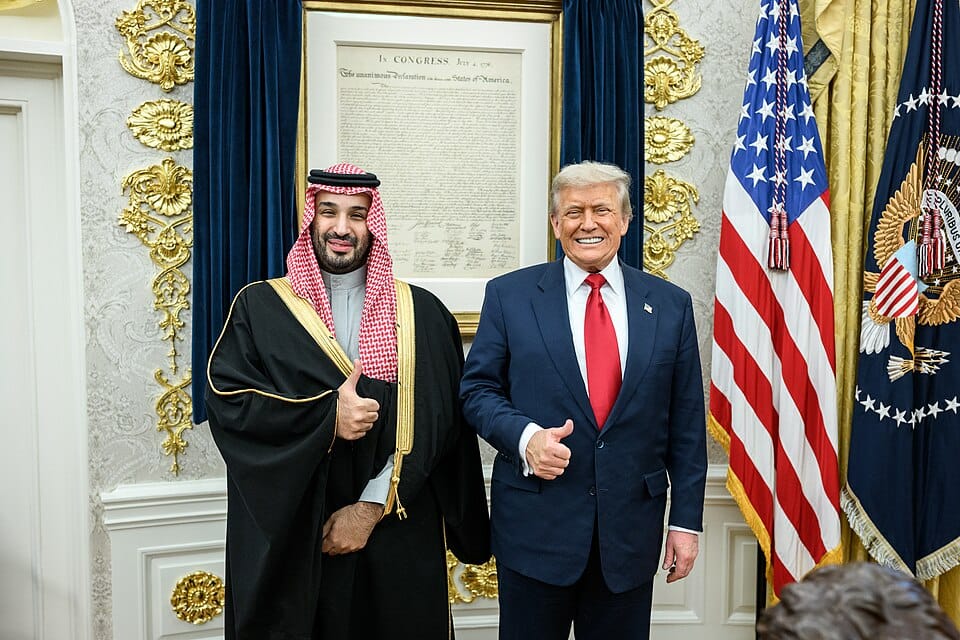
We begin with Saudi Arabia. One of the most interesting and public negotiations of these new tariff induced investments took place on November 18 in the Oval Office. Crown Prince Mohammed Bin Salman was visiting the President. With news cameras whirring in the background, the Prince leaned over to Trump and said he was upping his country's Pledge to a trillion dollars.
Although the President demurred, indicating that the $600 billion Saudi Pledge was sufficient, Trump then went on to say:
"That means investments in plants, in companies, money on Wall Street. And what it really means for everybody, what really counts is jobs. A lot of jobs. We have a lot of jobs," said the President.
https://www.foxnews.com/politics/saudi-crown-prince-bin-salman-hikes-committed-us-investment-nearly-1t
Exactly the point. The "investments" from foreign entities will go to private industry and Wall Street, not the US Treasury, as real tariffs would.
Now let's look at those four Pledges in depth:
Top Four Pledges:
Saudi Arabia
Pledged: $1 trillion (US) over 10 years
Yearly obligation: $100 Billion
Sovereign Wealth Fund: $1 Trillion (Yearly Pledge is 10% of SWF)
Saudi GDP: $1.27 trillion (2024) (yearly Pledge is 8% of GDP)
Probability of fulfilling Pledge: low to medium
Qatar
Pledged $1.2 trillion over 10 years
Yearly obligation: $120 billion
Sovereign Wealth Fund: $557 billion (annual pledge obligation is 22% of SWF)
Qatar GDP: $217 b (2024) (Annual pledge obligation is 55% of GDP)
Probability of fulfilling Pledge: extremely low
United Arab Emirates
Pledged: $1.4 trillion over 10 years
Yearly obligation: $140 billion
Sovereign Wealth Fund (combined): $2.2 trillion. Yearly obligation is 6% of SWF)
UAE GDP: $537 billion (e. 2024) Yearly pledge obligation is 26% of GDP)
Probability of fulfilling Pledge: low
Japan
In late 2024, before President Trump was inaugurated, Japan announced that it would significantly increase its defense spending. On February 8 of this year, President Trump ratified this spending, saying:
"Japan is committed to doubling its defense spending by 2027 compared to my first term. They've invested a lot of money, $300 billion in goods and services each year. And I'm pleased to say that this week, my administration approved nearly a billion dollars in foreign military sales to Tokyo."
The President is correct in noting, in the first instance, that this is a Japanese purchase; however, when he says it's a Japanese "investment," that is not the case. Further, this announcement was in February, two months before the President's April 2 roll-out of tariffs.
Japan should be removed from the list of Tariff/Investors.
Will these Countries be able to fulfill their Pledges?
A review of the top four trillion-dollar investors shows that Japan is not an investor at all; it is a buyer of US military goods. While this is a plus for our economy, calling it part of the "Tariff Strategy" is not credible.
Of the remaining three “Trillion Dollar Investors,” each elected a 10-year payoff; any analysis of the impact of these Pledges should be at the annual obligation rate, in other words, at one-tenth the total.
For each of these countries, Saudi Arabia, Qatar, and the UAE, their minimum annual contribution is at least $100 billion, representing from 6% to 22% of their Sovereign Wealth Fund, and from 8% to 55% of each country's GDP.
These amounts of Pledge Obligations would represent a substantial hardship on each country; even the largest economy, Saudi Arabia, is likely to be unable to fulfill its Pledge.
On the other hand, some of the lesser Pledges may represent a genuine future investment in the United States, which would be a positive for our economy. However, a review of the top 4 Pledged Countries suggests it is unlikely we will see anything close to the amount of funds promised.
Conclusion
What President Trump has done here is to change the language – tariffs no longer mean what we think they do. In Trump's world, tariffs now include any source of income he can think of. This is likely to shore up what is demonstrably a failing Tariff strategy. Tariffs are simply not bringing in enough revenue to be viable. At slightly over a quarter of a trillion dollars, there is not enough revenue to either pay down the nation's debt or provide significant tax relief for our citizens.
But this doesn't have to be the end of the world. American business managers sometimes strike out after promoting a new strategy that doesn't work. Sometimes we know why our ideas failed, sometimes we don't. But the essential attribute of any successful manager is the ability to correct course. When something doesn't work, you don't try to cover it up or pretend it does by adding specious "revenue." When the facts are clear, you change direction and correct the course.
Our review of the top four Investment Pledges, which the White House attributes to the Trump Tariff Policies, either have no relationship to tariffs, like Japan's, or would represent such a hardship on the "Investing" country that they're unlikely to be met.
Perhaps, Mr. President, it's time to change course.
**
Follow me here on ValueSide for more articles like this.