How Modern Iran Adopted The Strategies of 18th-Century Colonists
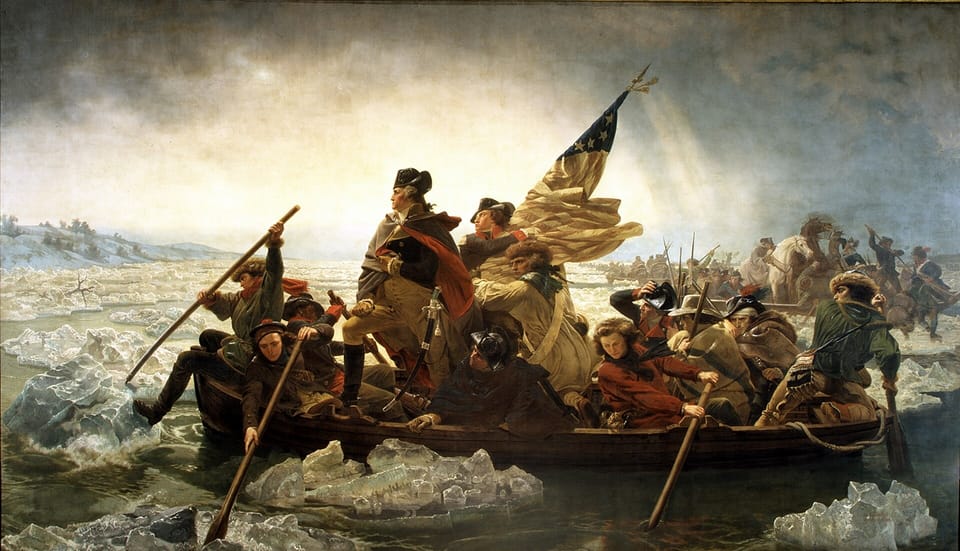
The legend of America began with the Revolutionary War of 1776. It was the struggle of a group of colonies in North America against the British Crown, the most formidable empire of its time.
The British Navy and Marines literally “ruled the waves” and controlled much of the world’s land and economy. It was a powerful fighting force, which had defeated most of its opponents by the mid-18th Century. Extremely well organized, the British operated under a strict hierarchy, with the Sovereign, King George III, at the head, and each successive military leader, be they a ship's captain or an army commander, in complete control of his soldiers. Authority came from the top. Each soldier was expected to obey orders without question, and to offer any resistance or rebellion was not tolerated.
In battle, the British army was readily identifiable by its distinctive crimson uniforms, earning it the nickname “Red Coats.” Obviously, this was not camouflage; rather, it was a way to facilitate quick identification to prevent any “friendly fire” accidents. Intriguingly, it indicated that the Brits did not consider their opponents to be much of a threat. It was as if they were saying, “As long as we don’t fire on our own men, little harm can come from the other side.”
Britain was a winner, a tried-and-true force proven over years of victory after victory. And its strategies and methods showed this reliance upon the reliable. Each opponent knew exactly what the British tactics would be beforehand: to march together and engage at close quarters, using the amazing “Brown Bess,” a smoothbore musket. It was a deadly effective weapon against anyone who stood in their way. This method was devastating toward armies that adopted the same traditional battle strategy.
All of that would change when the British came to America.
The first challenge for the English was logistics. Its forces first needed to trek the thousands of miles across the wide Atlantic, never an easy journey, but all the more so in the spartan quarters of the English vessels. And although they had occupied the American colonies for years and were well provisioned, the issue of communication, so important in the British hierarchical system, was problematic. Often, local commanders needed to request instructions from Headquarters in London, a process that could take weeks.
What’s more, the British were encountering a foe on their home turf, familiar with every nook and holler. While the Red Coats were in unfamiliar territory, struggling to gain their bearings. Making matters worse, those Americans refused to fight by accepted rules of engagement, choosing surprise attacks from hiding, rather than to “come out and fight like a civilized army.
Finally, the rebels were using a new kind of rifle, the long rifle. This innovative weapon was distinctive for its “rifling,” the grooves in the barrel that imparted a twist to the bullet, enabling it to fly with extreme accuracy over great distances. The Americans could stand far off and pick off the Brits one by one. It was a tactic the Redcoats had no defense against.
There was one final distinction between the British and the Americans during those fateful battles — culture. The British were a highly organized, top-down organization that relied upon its leadership for initiative and direction. Kill the leader, and an opponent would inflict a most serious and often devastating blow to the army of Great Britain.
On the other hand, the Americans were described as a ragtag group that would often come together only to fight, then return to their farms and homes. They were citizen soldiers, with little command structure. It made for a fighting force centered upon individual initiative, with little reliance on HQ.
Even though the Americans fought under the leadership of George Washington, the British likely knew that killing Washington would not have stopped the conflict; the Americans would, no doubt, have fought on.
Today’s Iran War
Today, we see a similar struggle playing out in Iran. It’s a place where a less powerful, less well-funded army struggles against the British Empire of today, the United States Military.
The United States Department of War is the best-funded military in the world, with an annual budget that exceeds the combined budgets of the next 10 countries. The US spends over a trillion dollars annually on its military, and under President Trump, it will increase that by 50% next year.
The US military has weapons and equipment that others can only dream of, with some of the most advanced systems and technologies anywhere. And yet, like the British of old, these are weapons and systems of a certain class — designed to oppose peer competitors, but, as we’re seeing in Iran, facing severe limitations in the current conflict.
However, as we examine the similarities between today’s Iran and 18th-century America, I’m struck by how closely they parallel each other. Iran likely studied the history of the United States and developed a strategy very similar to that of the American Colonists.
Like the British Empire, today’s US military faces a critical logistics issue. American forces must transit incredible distances to engage Iran. We’ve already seen that it can take days, if not weeks, for American ships to reach Iranian waters. Today, a transport vessel from California is still steaming its way to the Persian Gulf — a trip that’s likely to take a couple of weeks.
Once US forces reach Iran, and especially if they are to invade, then provisions must be made for the soldiers and sailors. While the British had established bases in America, today those bases will need to be built, no doubt while under Iranian missile and drone attack.
While American military operations are highly structured, with tactics and instructions issued from Headquarters, modern communications have made this process faster and more accessible. So, unlike the British of old, today’s American soldiers, sailors, and pilots have instant communication.
On the other hand, the Iranians have demonstrated a non-hierarchical structure — much like the American colonists. When the Americans killed the Ayatollah, Iranian operations did not stop, but continued as before. It is because Iranians have distributed operational initiative downstream to the operational level. They call this their “mosaic” system, and it’s one of the areas that closely parallels 18th-century America.
Another parallel exists in military hardware. The American long rifle was a technologically advanced weapon over the British blunderbuss. Today, the Iranian hypersonic missile is technologically advanced relative to American systems (to the extent that America has shown its most advanced missiles) and, more importantly, over US interceptors like the Patriot and/or THAAD Systems.
In contrast, the Iranian drone systems are a step back in time, to a less sophisticated, but easy and inexpensive to produce weapon. With the right components, drones, like the Shahed Drone, can be assembled in the backyard. Easy to make, deadly with the proper guidance. These drones have been devastating against an Israeli and American anti-missile system.
While America has built the best Army, Navy, and Air Force that money can buy, Iran has constructed what it can.
Overall, Iran has built a fighting force based on the materials and capabilities available to it. Remember, this is a country that has been under heavy US sanctions for years. The result has been that Iran’s air force is substandard in the modern world, with some of its jets that are decades old. Iranian soldiers do not have all of the technology that American soldiers do. Iran’s Navy is far less capable than the US Navy and consists mainly of small speedboats and unmanned surface vessels.
Any one-on-one comparison of Iran’s military capabilities with the United States would show US superiority. And this has led to a fatal mistake on the part of US War Planners, one that we’ve made before.
It is a struggle that is far more than war. It is a struggle for Iran’s existence. In America, we call this regime change. Something that Washington likely measured by comparing military might. But that analysis omits the struggle for the hearts and minds of the Iranians.
Just as 18th-century American colonists fought for their homeland, Iran is fighting to remain a nation and will use every method and resource at its disposal to do so.
**
Follow me here on ValueSide for more articles like this.