The King's Gambit: What Donald Trump Risks In Venezuela
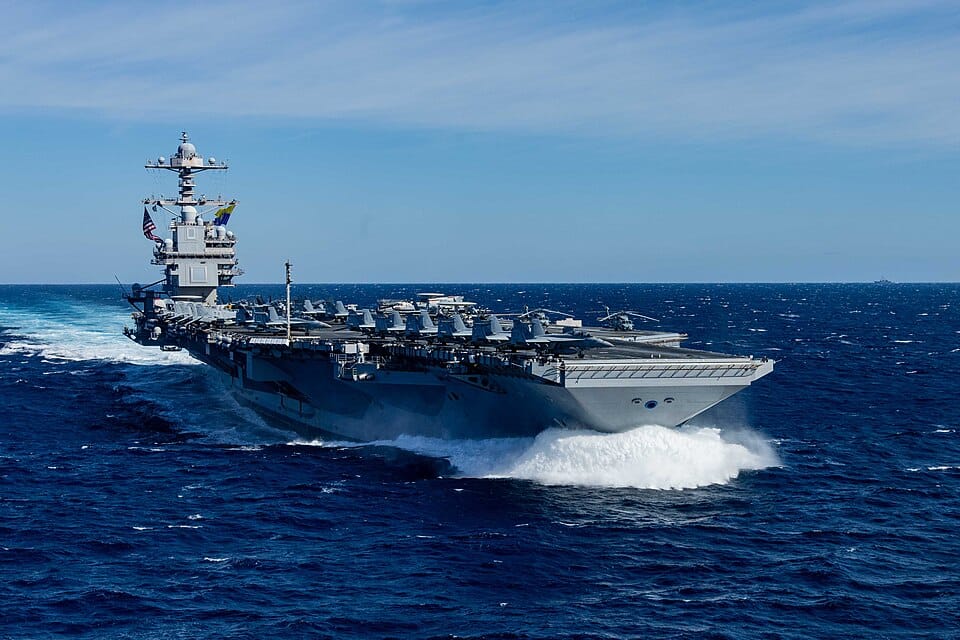
In the game of Chess, one type of move is considered to have more risks than any other. It is a move that puts at risk a player's most valuable asset, in the game of Chess that player is the King, in the geopolitics of the Navy, it's the United States' premier battle ships, the massive Aircraft Carriers.
Today, the largest, most advanced American Aircraft Carrier patrols just offshore of Venezuela, ready to leap into action at the command of the President. That call to action occurred on November 29, when President Trump wrote, in a Truth Social Post:
"To all Airlines, Pilots, Drug Dealers, and Human Traffickers, please consider THE AIRSPACE ABOVE AND SURROUNDING VENEZUELA TO BE CLOSED IN ITS ENTIRETY."
Without a doubt, it will be the Ford (CVN-78) that enforces the President's no-fly directive. With over 4,500 sailors and airmen on board, the Ford is used to the extreme pressure of this type of high-intensity operation, having recently returned from operations in the Middle East.
On board the Ford is Air Wing 8, one of the elite American attack groups, which will have the chief responsibility for the interdiction of any stray aircraft over Venezuela.
The Ford is accompanied by a fleet of support vessels, including three amphibious assault vessels that transport US Marines, Helicopters, and ground-attack aircraft. All positioned for a potential invasion. Additionally, the flotilla includes a nuclear submarine and no fewer than six Arleigh-Burke Class destroyers. It is the destroyers that may be at the heart of any potential conflict.
These state-of-the-art destroyers are fitted with the Aegis Combat System, which finds and destroys enemy missiles, planes, and ships across the battlefield. The Aegis System is designed to act as the eyes and ears throughout the Caribbean, directing both offensive and defensive operations – controlling the ground, sea, and air around Venezuela.
The Risk
Usually, the Gerald R. Ford travels with four Aegis-class destroyers; however, for this mission, it will be escorted by six Aegis-class destroyers. While the Ford and its usual support group would be more than enough to handle any air or sea operation against Venezuela, we can assume that something else has alerted US Southern Command to an additional threat, one beyond Venezuela's military capability.
That threat is Russian Military Technology.
All year long, that Russian threat has been commanded by Colonel General Oleg Leontievich Makarevich, according to a report in The War Zone. His presence is part of a long-standing military exchange between Venezuela and Russia, and began long before the current standoff between the United States and Venezuela.
https://www.twz.com/news-features/russian-general-in-venezuela-leading-advisory-mission-ukraines-intel-chief.
Makarevich and the 120 or so Russian soldiers that he commands present Russia with a ready base to supply Venezuela with additional arms and equipment in the face of any action by the US Military. Here, Russia is playing much the same role as America does in the Ukraine war – supplying arms and expertise to an ally.
As the USS Ford moved into the Caribbean, Russia countered by supplying anti-aircraft missile systems (Pantsir-S1 and Buk-M2 ) to Venezuela, in addition to several advanced fighter aircraft.
https://www.businessinsider.com/russian-lawmaker-send-pantsir-buk-venezuela-air-defenses-ilyushin-2025-11.
It is consistent with a strategy Russia has used before, a parallel escalation matching the American threat. So, the chessboard unfolds. Russia supplies Venezuela with anti-aircraft systems to counter American fighters and bombers, launched not just from the Ford, but also from mainland America.
At this point, it's almost impossible to predict what's next. Much will depend upon the decisions made by US President Donald Trump. Recently, a call between President Trump and Venezuela's President Nicolas Maduro, where Trump reportedly demanded that Maduro resign the Presidency and leave the country, was rejected by Maduro.
A couple of days later, Trump ordered a no-fly zone to cover the entire country of Venezuela, an action generally considered an act of war. This latest strategy by the President is only a few days old; it will likely take many more days to determine its impact. But note: up to now, the Russian-supplied arms and equipment have arrived by plane, which is now blocked. It would also be tough for Russian ships to navigate through the American armada. It may have been the real reason that Trump instituted the no-fly zone.
For the US President, he must understand precisely what Russia has already supplied to Venezuela. All of the reports we've cited so far reflect information derived from various American spy satellites and aircraft circling over the South American country. Of course, the President has a much more thorough and timely view of the conflict directly from the various American spy agencies.
Here's why Trump cannot make a wrong move.
The Pentagon likely instructed the President to curtail all additional Russian-supplied arms to Venezuela, because there is one weapon that is of utmost concern for the US Military. That weapon is the growing number of hypersonic missiles Russia has developed. Among those, Hypersonic is the sea-based Zircon, as well as the seven-year-old, battle-tested Kinzhal.
But most concerning is the newer Oreshnik Missile. This hypersonic missile was launched on November 21, 2024, against the Pivdenmash factory in Dnipro, Ukraine. No doubt chosen because it was one of the most fortified targets in all of Ukraine. The Pivdenmash facility was built during the Soviet era and extended for at least three stories underground, designed to be invincible to the Soviets of that time.
The Oreshnik attacked without explosives; sheer kinetic energy destroyed the factory to its foundation. Traveling at Mach 10 (10 times the speed of sound), the Oreshnik used MIRV (Multiple Independent Warheads) to evade American air defense, including the Patriot Anti-missile system, and utterly devastate its target.
One year after the Oreshnik's attack in Ukraine, it remains an open question whether the United States has an effective counter to this missile. While much of the information regarding US anti-missile systems under development is strictly classified, two systems appear promising.
The first is the Navy's HELIOS (High Energy Laser And Integrated Dazzler And Surveillance) system. An onboard laser system capable of intercepting incoming missiles. However, to date, the HELIOS System has been tested only against the much slower Cruise Missiles.
https://www.navalnews.com/naval-news/2025/02/u-s-navy-helios-laser-test-underscores-greater-advancements-in-directed-energy-weapons
The other publicly disclosed anti-missile system in the American arsenal is the THAAD (Terminal High Altitude Area Defense) System. You may be familiar with the THAAD System when Israel used it in its recent conflict with Iran. THAAD is the most advanced system available. Unfortunately, only eight of these expensive systems exist, and recently, President Trump gave a second system to Israel. Of the six systems remaining in the United States, none are reported to be operational in the Caribbean, where the USS Ford is now.
Therefore, unless the United States has a top-secret anti-missile system that hasn't been disclosed, the Ford would be vulnerable to an Oreshnik (or other hypersonic) attack.
In Chess, the King's Gambit occurs when the King risks his most valuable piece. It is a move that is sometimes successful but highly risky, because should he lose, the game is over. Such is the Gambit that President Trump now exercises in the Caribbean with the USS Gerald R. Ford.
Follow me here on ValueSide for more articles like this.