Want To Know What's Happening In Iran? Watch The Carriers, Don't Listen To The Politicians
For the second time in seven months, the United States stands at the precipice of another military conflict with Iran. For the average citizen, like you and me, it is often difficult, if not impossible, to determine how and why these conflicts have come about. Iran, after all, is a country far away from the United States and with limited military capability. A direct attack on U.S. shores is unlikely, and no provocation has yet occurred. Such an attack would be grounds for retaliation under the War Powers Resolution of 1973.
However, by following the timeline of Operation Midnight Hammer on the Saturday evening of June 22, 2025, we can gain insight into how the Iran War I (the 12-Day War) began and how the next Iran War is likely to begin.
To the casual observer, it appeared to be a spontaneous event, triggered by a negative report by the International Atomic Energy Agency, indicating that Iran had begun development of a nuclear weapon. Reacting to these revelations, President Donald Trump then ordered the attack on Iran’s nuclear enrichment facilities.
But what if I told you that a careful reading of the events leading up to Operation Midnight Hammer presents a very different picture, one that is entirely devoid of the supposed spontaneity of the IAEA report.
In articles published by the Washington Post and the Jerusalem Post (on December 17, 2025), both newspapers report that Prime Minister Benhamin Netanyahoo and President Donald Trump first began planning a joint attack against Iran on February 4, 2025.
“Prime Minister Benjamin Netanyahu and US President Donald Trump began planning for a potential strike on Iran’s nuclear program after a meeting in February 2025, and developed an elaborate public deception program…”
https://www.timesofisrael.com/report-netanyahu-trump-planned-iran-strike-far-in-advance-ran-deception-campaign/
In other words, less than a month after becoming the nation’s 47th President, in one of his first meetings with a foreign leader, Trump was already planning to attack Iran.
Spontaneous indeed.
Later, we would discover that the IEAE report was also suspicious, likely part of that “deception program” that the two leaders mentioned in this initial meeting.
Military preparations began immediately. There was much to do, and little time to waste.
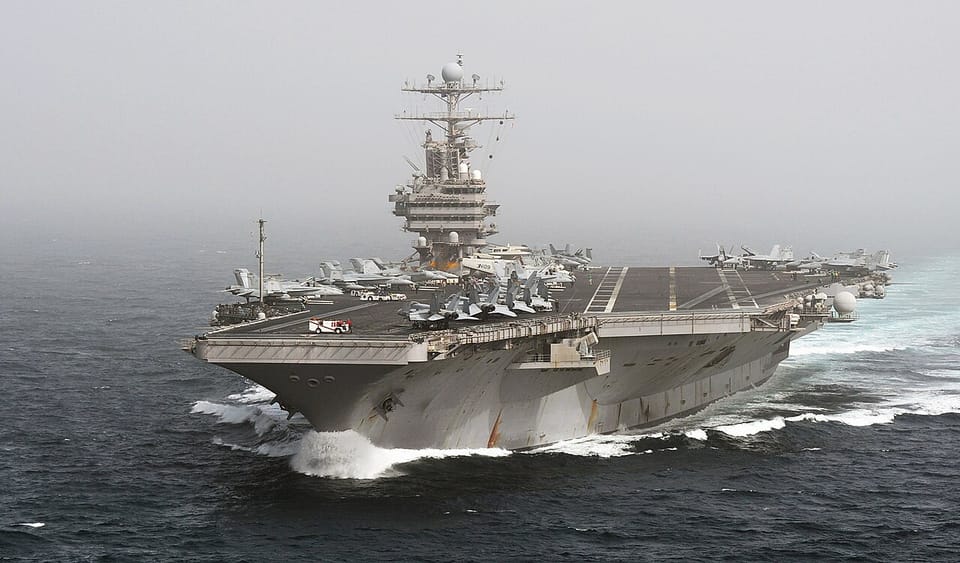
On March 21, 2025, Secretary of Defense (then) Pete Hegseth directed aircraft carrier USS Carl Vinson (CVN 70) and its attack group to the Persian Gulf. The Vincent was tasked with the twin objectives of supporting the USS Harry S. Truman (CVN 75) in Operation Rough Rider, which aimed to mitigate the Houthis’ attacks on international shipping and deter Iran’s military from any future action.
On May 6, 2025, President Trump ordered that Rough Rider was suddenly over. Even though it was unclear whether Rough Rider had achieved its objectives. Were the Houthis contained? Is international shipping safe for cross-gulf shipping? The answer turned out to be yes, shipping was safe, but not for Israeli-bound cargo.
It was becoming increasingly likely that President Trump had another mission for his Carl Vincent “Armada,” one that would ultimately involve Iran. It was all part of the plan, the plan worked out between the leaders of Israel and the United States.
By early April 2025, US Naval assets were in place, with the USS Carl Vincent “Armada” prepared for any eventuality. Now it remained for the US Air Force to carry out one of its most daring and ingenious raids ever, and for the US President to initiate the White House’s most influential weapon, deception.
So, for a little more than a month, President Trump and Israeli Prime Minister Netanyahoo performed political “kabuki.” They acted as if they were entirely independent from one another. But as events unfolded, there was little doubt that the complex logistics and military staging required by Israel and the United States in their attacks demonstrated extensive coordination and planning between the two countries.
On June 13, 2025, Israel began the Twelve-Day War when the IDF Air Force began combat missions.
Astonishingly, there’s almost no resistance. The vaunted Iranian air defense is nearly silent — antiaircraft batteries did not respond, anti-aircraft missiles did not launch.
Later, we would discover that Israel’s Mossad had infiltrated Iran’s defenses and cut off command and control of Iran’s defense systems. It became clear that this Israeli attack had been months in the making and had caught Iran completely off-guard.
However, within less than half a day, the IRGC (Iranian Revolutionary Guard Corps) reestablished vital military coordination and communications and began providing substantial counterstrikes. During this time, there was one unsubstantiated report that the Iranian air defense radar had “locked on” to the stealthy American-produced F-35I Adir Fighter, a derivative of the Lockheed Martin F-35, which, up to now, was considered so stealthy that it was “invisible” to most radars.
After Iran reconfigured its command-and-control, the tables began to turn. The IAF Air Force returned home, and from that point on, the War became a series of missile volleys, with both sides sustaining substantial damage. As the War continued, it appeared that Iran was successfully penetrating the vaunted Israeli “Iron Dome,” consisting of both the US and Israel’s top-of-the-line anti-aircraft systems.
No analysis of the Twelve Day War is complete without acknowledging Washington’s important role in its initial stages. Remember in the February meeting between Trump and Netanyahoo, one of the key components of the War was deception.
Throughout the days leading up to the conflict, President Trump urged negotiation, encouraging Iran to meet with his representatives. By early June, Trump had convinced the Iranians to meet with his special envoys, Steve Whitcoff and Jerrod Kushner, to hash out any remaining details for a lasting peace.
The meeting was scheduled for June 14, 2025. As we all know, the meeting never took place; Israel attacked the day before (June 13, 2025). It’s interesting to note that this was the same tactic as used by the Japanese on December 6, 1941, when they held diplomatic negotiations with the Americans before bombing Pearl Harbor the next day (December 7, 1941).
In yet another indication of the extent of the planning and logistics behind the Israeli/American effort, Operation Midnight Hammer commenced on the evening of Saturday, June 21, 2025. The objective of the raid was to hit Iran’s nuclear facilities at Isfahan, Fordow, and Natanz.
First came a wave of America’s most advanced fighter jets, F-22 Raptors, F-15E Strike Eagles, and the F-35 Lightning II. After the fighters cleared the skies, the B-2 Bombers dropped 14 Bunker Buster Bombs (GBU-57). Each of the B-2s flew a nearly 14,000-mile round-trip from their base at Whiteman Air Force Base, Missouri, to Iran and back. In all, the Bombers needed 30 air tankers to fuel this incredible round-trip.
Again, this was no last-minute operation, no spur-of-the-moment reaction to an adverse Atomic Energy report. It was a well-planned, flawless-executed operation that was, no doubt, months in the making. Just like the operation in Venezuela, when you see that US Carrier Battle Group (Trump’s “Armada”) sitting offshore, you can count the days until they strike.
Lessons from Iran War I — the 12-Day War.
The first lesson is that the current conflict dates back many years, possibly even to the time of the Iranian Shaw. Israel’s motivation is likely to be taking out its most formidable opponent in the Middle East. For America, its twin motivations are likely to support its principal Middle Eastern ally and now oppose one of the leaders of the BRICS movement.
The second lesson, as reported by the Washington Post, deception is a principal weapon in the War; each side, Washington, Tel Aviv, and Tehran, is not to be trusted as a source of truth and veracity.
So, don’t listen to what leaders on either side of this conflict say. Watch what they do; actions speak volumes. And the most visible action currently is the positioning of the USS Abraham Lincoln “Armada.”
Epilogue: Forbes reports that the USS Abraham Lincoln (CVN 72) was ordered to the Middle East (Presumably the Persian Gulf) from its location in the Indian Ocean. (January 15, 2026). A more recent Forbes report indicates that the Lincoln may be supported by the George HW Bush (CVN 77) (January 21, 2026).